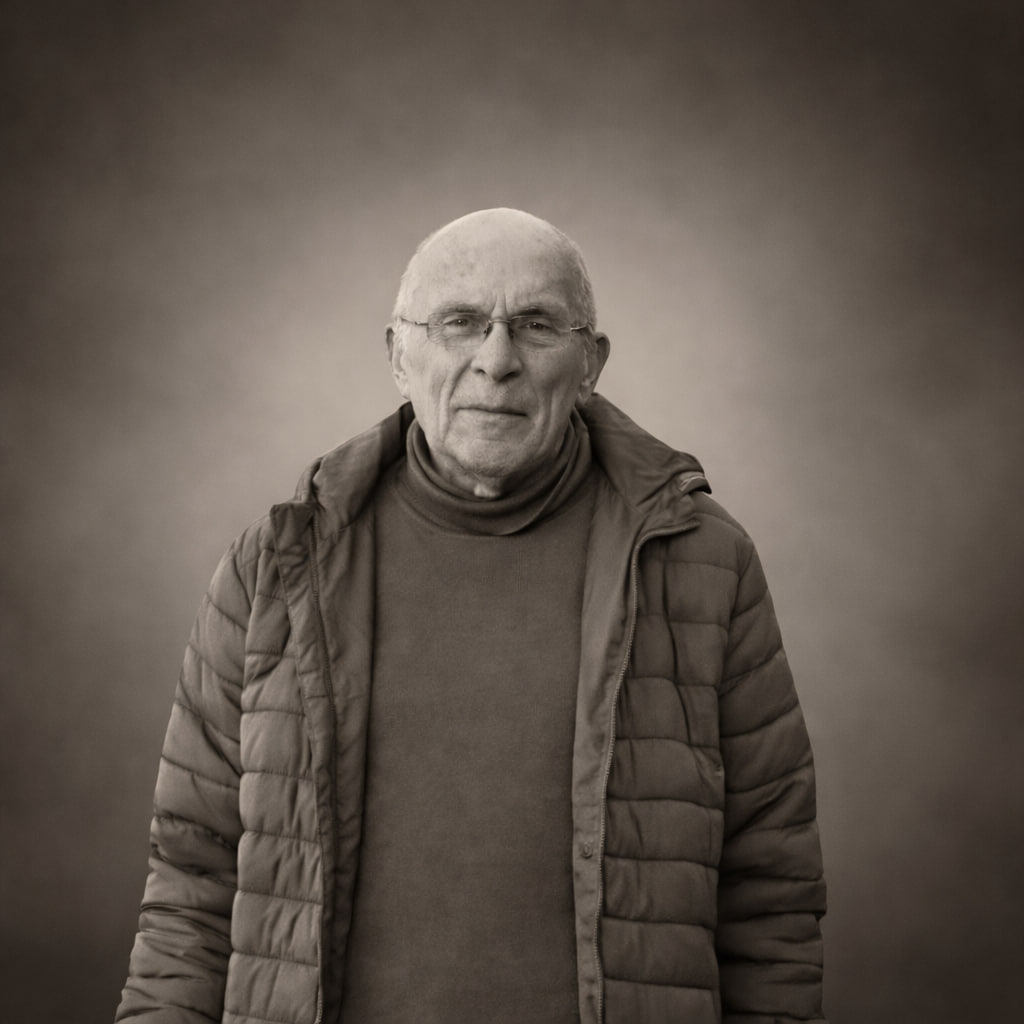
Oleg Ivanovych Levchenko was born on 4 September 1946 in Volochysk, Podolia, in what was then the Kamianets-Podilskyi region. In 1950 his family moved to Proskurov, now Khmelnytskyi, where he spent his childhood and school years.
He grew up in a large family as one of four children. From an early age, responsibility, independence and respect for work became part of his character — not as abstract values, but as a natural way of life. During these years he also developed an interest in exact sciences and an engineering way of thinking: calm, systematic and demanding of detail.
After school he entered the Kyiv Polytechnic Institute, choosing the Department of Microradioelectronics. He graduated with honours — as a person for whom the principle of “doing it properly” was not a slogan, but an internal standard.
Life and Work
Oleg Ivanovych continued his professional career in science. In the late 1970s he worked at the V. M. Glushkov Institute of Cybernetics of the Academy of Sciences of the Ukrainian SSR, where he was engaged in applied scientific research and engineering design. His work was connected with state and industry projects, and a number of developments were protected by inventor's certificates and patents.
In time he became head of a specialised design bureau, while remaining not merely an administrator, but an engineer — precise, demanding and focused on practical results.
After the collapse of the Soviet Union, he did not leave science and engineering behind. Instead, his attention shifted towards practical solutions for everyday life — construction, thermal and energy-saving technologies, where precise calculation directly affects durability, comfort and the quality of the built environment.
He developed new materials, built technological processes, helped establish production and brought solutions to the point where they could work for decades. For him, inventing something was never enough. It had to work.
Milestones
Born in Volochysk, Podolia.
The family moves to Proskurov, now Khmelnytskyi.
Kyiv Polytechnic Institute. Department of Microradioelectronics. Graduated with honours.
V. M. Glushkov Institute of Cybernetics. Applied research, state and industry projects, inventor's certificates and patents.
Development of materials, technological processes and solutions designed for durability and practical application.
Formation of an engineering foundation and philosophy combining precision, responsibility, resource awareness and practical application.
Engineering Legacy
The final years of his work became a natural continuation of everything that had come before. Oleg Ivanovych sought to create materials and systems in which engineering precision, environmental responsibility and practical applicability could coexist without temporary solutions or compromises that undermine the final result.
He did not see building materials merely as commodities, but as elements of the environment that should be predictable, durable and understandable in their behaviour. For him, durability was not only a technical characteristic, but also a form of responsibility — to people, resources and time.
This is how the engineering foundation of ECOS evolved — not as a single product or universal recipe, but as the result of many years of work with mineral materials, technological processes and applied engineering solutions.
Work with mineral systems, the possibility of reducing dependence on conventional cement, thermal storage technologies and other engineering directions developed around one principle: an engineering solution should be verifiable, practical and designed for long-term service.
Today this engineering legacy continues to evolve within the ECOS technology system.