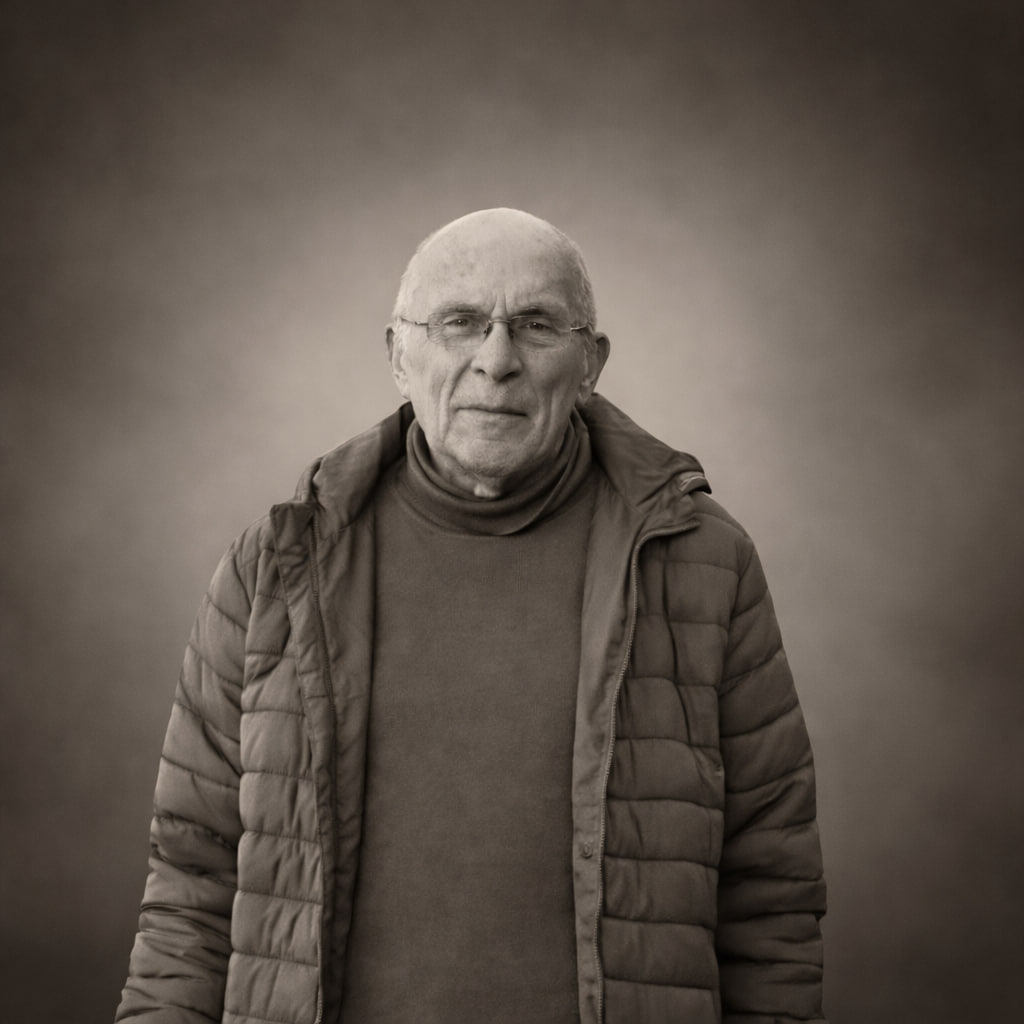
Levchenko Oleg Ivanovich
December 10, 2025
ECOS LEGACY
· Engineering · Memory · Philosophy
“He lived his life searching for precise solutions, honest materials, and ideas that make the environment around us safer and better.”
Oleg Ivanovich Levchenko was born on September 4, 1946, in Volochysk, Podolia, in what was then the Kamenets-Podolsky region. In 1950, his family moved to Proskuriv (now Khmelnytskyi), where he spent his childhood and school years.
He grew up in a large family, one of four children. From an early age, responsibility, independence, and respect for work were formed in him not as abstract values, but as a natural way of life. It was during these years that his interest in exact sciences and engineering thinking took shape: calm, systematic, and demanding toward details.
After school he entered the Kyiv Polytechnic Institute, choosing the Department of Micro-Radioelectronics. He studied with honors and graduated with a red diploma, as a person for whom the principle “done correctly” was not a slogan, but an inner standard.
Life Path
Oleg Ivanovich continued his professional career in the scientific field. In the late 1970s, he worked at the V. M. Glushkov Institute of Cybernetics of the Academy of Sciences of the Ukrainian SSR, where he was engaged in applied scientific and design work. His projects were related to state and industrial programs, and his developments were protected by numerous authors’ certificates and patents.
Over time, he headed a special design bureau, remaining not a purely administrative head, but an engineer: precise, demanding, and focused on real results.
After the collapse of the Soviet Union, he did not abandon science and engineering. On the contrary, his focus shifted toward practical solutions for real life: construction, thermal systems, and energy-saving technologies, where accurate calculation directly affects durability, comfort, and the quality of the environment.
He developed new materials, built technological processes, launched productions, and brought solutions to a state where they could be used for decades. For him, it was important not only to invent. It was important to make it work.
Milestones
Born in Volochysk, Podolia.
Family moved to Proskuriv (now Khmelnytskyi).
Kyiv Polytechnic Institute. Department of Micro-Radioelectronics, honors diploma.
Glushkov Institute of Cybernetics. Applied research, state and industry projects, authors’ certificates and patents.
Development of materials, technological processes, creation of solutions focused on durability and real-world application.
Formation of an engineering system and philosophy combining precision, environmental responsibility, and practicality.
Engineering Legacy
The last years of his work became the logical outcome of everything he had gone through.
Oleg Ivanovich sought to create materials and systems where engineering precision, ecological responsibility, and practical applicability coexist simultaneously, without compromises and temporary fixes.
He viewed building materials not as a commodity, but as an element of the environment that must be honest: predictable, durable, and transparent in its behavior. For him, durability was not merely a technical characteristic, but a form of responsibility toward people, resources, and time.
This is how the ECOS system appeared. Not as a single invention and not as a commercial product, but as a collected formula of his entire engineering life. Dry building mixes with minimal or zero Portland cement, concrete heat-accumulator technologies, ecological aggregates and new-generation crushed stone became the continuation of one principle: engineering should serve for decades, not for marketing cycles. ECOS did not become the result of one project, but the outcome of an engineering way of thinking shaped by years of precise calculations, practice, and responsibility for results.
ECOS Manifesto
ECOS is an engineering project, not a product line. We are not creating yet another mix. We are building a system of solutions based on precise calculation, responsibility, and respect for resources.
While others compete on price and race to the bottom, the result is faceless and short-lived buildings that first harm the environment during production and then again during demolition. We are not part of that race.
Others sell bags of cement and sand. We offer an engineering philosophy embodied in material.
Others compromise for speed and cost. We refuse simplifications that destroy the final result.
For us, engineering comes before accounting. Decisions are made based on reliability and service life, not short-term savings.
We work with honest materials: controlled in composition, predictable in behavior, and transparent in logic.
We see durability as a form of responsibility. Buildings must serve for decades, not marketing cycles.
Ecology is not a slogan for us. CO₂ reduction is achieved through materials, thermal engineering, and precise calculation, not “green” marketing.
ECOS is not created for everyone. It is for those who build legacy, not just square meters.
We do not make temporary solutions. We create what must work for a long time, and work correctly.
Today, the ECOS project is being developed by a new generation of engineers and partners who continue this path. The principles of precision, durability, and respect for resources remain unchanged and are applied to modern construction tasks in different countries, climates, and regulatory environments.